Lab Grown vs Natural Diamonds: What Retailers Need to Know
A retailer's guide to lab grown vs natural diamonds: margins, sourcing, lead times, and how to stock both without guessing on price.
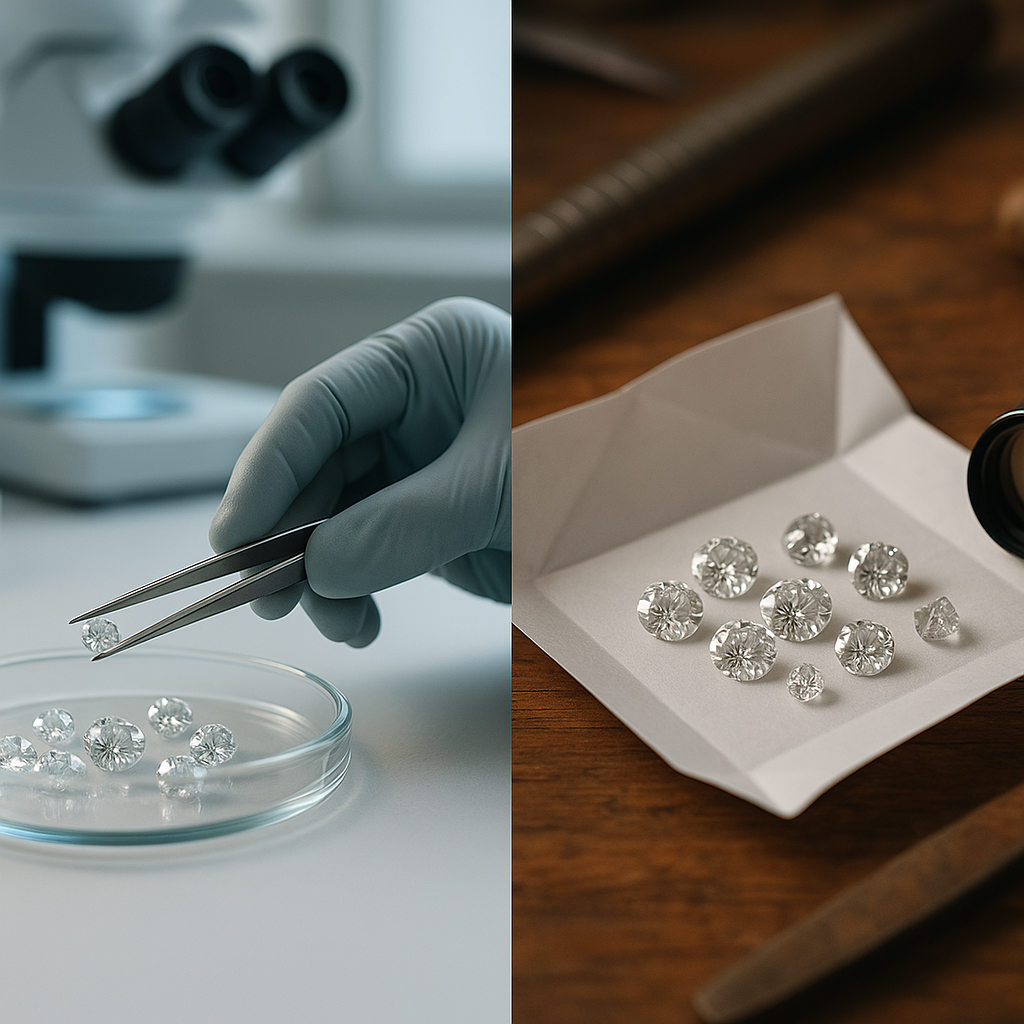
Lab grown wins on margin, speed to shelf, and flexibility in unusual shapes. Natural still wins on resale narrative and a segment of customers who will not budge on "mined." Most independent retailers end up stocking both, and the real decision is how you split your buy and who you source each from.
The question behind the question
When a retailer asks "lab grown vs natural diamonds," they are rarely asking about chemistry. They already know a lab grown diamond is chemically identical to a mined one, graded on the same 4Cs scale, verified under the same equipment. The real question is: which one makes me more money per case, with less dead stock, and fewer customer disputes at the counter?
That is a sourcing and merchandising decision, not a gemology lecture. This page compares the two on the criteria that actually move a buying decision: cost, margin, customer fit, lead time, risk, and support.
Cost and margin, the honest numbers
Lab grown diamonds typically cost 60% to 85% less than a natural diamond of comparable size, cut, and clarity. A 1.5 carat natural round costing $8,000 to $12,000 wholesale has a lab grown equivalent in the $1,200 to $2,500 range depending on cut quality and certification.
That price gap is shrinking natural diamond margins across the industry, which is exactly why more shops are adding lab grown lines rather than fighting the trend. Retailers who stock lab grown alongside natural generally report that lab grown lets them sell larger, more dramatic stones to the same budget customer who would have settled for something smaller in natural.
Margin percentage on lab grown can actually run higher for retailers, even though the sticker price per stone is lower, because wholesale cost has compressed faster than retail price expectations. The catch is volume: you need to move more units to hit the same gross profit dollars, so your display case and sales script both need to work harder.
Our own sourcing team's take: a shop that prices lab grown at "a bit less than natural" is leaving money on the table twice over. Price it on its own merits, built around the stone and the setting, not as a discount version of something else.
Customer fit: who actually wants which
Private customers commissioning engagement rings fall into a few repeatable groups:
- Budget-stretchers: want a bigger, cleaner stone than natural allows at their price point. Lab grown is the clear answer.
- Heirloom-minded buyers: want "real" in the sense of rarity and resale story. Natural is the fit, and you should not argue them out of it.
- Design-first buyers: care more about an unusual shape, a portrait cut, or a fancy cut than about origin. This group is where lab grown earns its keep, because custom and rare cuts are far more affordable to commission in lab grown.
- Undecided buyers: the largest group in most shops. They need a clear, non-judgmental comparison at the counter, not a sales pitch toward whichever has better margin that week.
For independent shops, the design-first and undecided groups are where lab grown converts fastest, especially when you can show a shape nobody else in town carries.
Lead time and availability
Natural diamonds in standard rounds and princess cuts are available same day from most wholesale networks. Unusual natural shapes in large sizes can take months to source, if they turn up at all, and pricing swings with every find.
Lab grown removes most of that uncertainty because the stone is grown to a specification, not discovered. Custom-cut lab grown stones in shapes like Portuguese cut, criss cut, or shield cut typically ship in 2 to 4 weeks for a single stone, and 4 to 6 weeks for matched pairs or multi-stone orders, once the cutting specification is confirmed.
That is a meaningful advantage for a retailer who has promised a customer a ring by a specific date, especially around proposal season when timelines are tight and non-negotiable.
The comparison table
| Criterion | Lab Grown Diamonds | Natural Diamonds |
|---|---|---|
| Wholesale cost (comparable size/quality) | 60% to 85% lower | Full market price, sets the reference point |
| Margin potential | Higher percentage, needs volume | Lower percentage, higher dollar-per-unit |
| Lead time for standard shapes | 1 to 3 weeks | Same day to 1 week |
| Lead time for unusual/custom shapes | 2 to 6 weeks, made to spec | Weeks to months, subject to availability |
| Size for budget | Larger stone per dollar | Smaller stone per dollar |
| Customer segment fit | Budget-conscious, design-first, younger buyers | Heirloom-minded, resale-focused buyers |
| Certification | IGI, GIA grading available, origin disclosed | GIA, AGS grading, origin disclosed |
| Resale perception | Still building market acceptance | Established, though resale value is often overstated by sellers |
| Risk to retailer | Price compression over time | Supply volatility, price swings |
| Best use case | Larger carat weight, custom shapes, portrait cuts | Classic solitaires, heirloom pieces, traditional buyers |
Where natural still wins
It is worth saying plainly: if your customer base skews toward collectors, estate-style pieces, or buyers for whom "mined and millions of years old" is part of the emotional purchase, natural diamonds remain the better fit. Natural also has a longer track record in the secondary and auction markets, something lab grown has not yet built at scale.
A shop that only stocks lab grown risks alienating a real and durable segment of buyers who are not price-driven at all. The honest position for most retailers is a dual inventory, not a full switch.
Risk: what can go wrong with each
Lab grown risks:
- Price erosion. Wholesale costs for lab grown have fallen steadily and may continue to, which can strand retailers holding higher-cost older stock.
- Customer skepticism from buyers who confuse "lab grown" with "simulant" or "fake," a messaging problem more than a product problem.
- Inconsistent supplier quality on cut precision, especially in unusual shapes where a bad cutter shows immediately.
Natural risks:
- Supply volatility and price swings tied to mining output and global demand.
- Longer sourcing time for larger or unusually shaped stones.
- Rising customer awareness of lab grown alternatives, which puts pressure on natural margins at the point of sale.
A data point worth knowing: the Gemological Institute of America (GIA) grades and certifies both lab grown and natural diamonds using the same 4Cs framework, which is part of why retailers can present both with equal confidence in paperwork and appraisal.
Time to value: how fast each inventory choice pays off
If you are deciding where to put your next buying dollar, think in terms of time to value, not just unit cost.
- Lab grown melee and standard shapes: inventory turns fast, usually within a season, because price point draws in a wider customer pool.
- Lab grown custom and fancy cuts: slower individual turn, but higher ticket per sale and strong word-of-mouth from customers who could not find the shape anywhere else.
- Natural standard rounds: steady, predictable turn but thinner margin per unit as lab grown competition grows.
- Natural rare or large stones: can sit for months, but command the highest single-sale dollar amount when they move.
Support and sourcing: what actually matters
A wholesale relationship is not just a price list. The things that save a retailer time and prevent costly mistakes are:
- Consistent cut quality across repeat orders, so matched pairs and sets actually match.
- Clear certification that your sales staff can explain in one sentence to a customer.
- Reasonable minimum order quantities that do not force a small shop into carrying more stock than it can sell in a quarter.
- Realistic lead times communicated upfront, not discovered three weeks into a customer's wait.
- Responsive customization when a customer or designer asks for something outside the standard shape list.
This is the space Bespoke Carat works in. We manufacture and supply lab grown diamond jewelry and custom-cut lab grown diamonds for jewelers, independent shops, and mid-size retailers across the US and Canada, with a focus on unusual shapes, portrait cuts, and fancy cuts that are hard to source elsewhere. Pieces like the Portuguese Cut Lab Grown Diamond, the Criss Cut Lab Grown Diamond, and the Shield Cut Lab Grown Diamond Matching Pair are the kind of stock that lets a retailer offer something a competitor three towns over simply does not carry. For retailers building out a classic line alongside unusual cuts, our Emerald Diamonds collection covers the step-cut staple that every case needs.
Minimum order quantity, lead time, and how quotes work
For wholesale buyers, minimum order quantities scale with stone type:
- Melee and small standard shapes: MOQ is typically set in carat-weight batches rather than per-stone counts, making it practical for shops restocking a case.
- Custom-cut fancy shapes: MOQ can be as low as a single stone for a specific client commission, or a small batch for shop inventory.
- Matched pairs and sets: ordered together to guarantee color and cut consistency, with lead times running 4 to 6 weeks.
Lead time depends on the shape and finish requested:
- Standard shapes already cut: 1 to 2 weeks including quality check and shipping prep.
- Custom and fancy shapes cut to order: 2 to 4 weeks for a single stone.
- Full custom jewelry pieces built around a commissioned stone: 4 to 8 weeks depending on setting complexity.
Packaging and international shipping are built around safe transit and customs clarity, with documentation that matches certification so a retailer or private client is never stuck explaining a mismatch at the border.
Requesting a quote is a short process: describe the shape, size, and quantity you need, confirm certification requirements, and expect a cost and lead-time estimate back before committing to an order. For private clients commissioning a single custom piece, the same process applies, just scaled to one stone and one setting.
Frequently Asked Questions
Can customers tell a lab grown diamond from a natural one by looking at it?
No. The two are optically and chemically identical, and the difference only shows up under specialized lab equipment used by certifying bodies like GIA or IGI. Sales staff should be upfront about this rather than treating it as a hidden detail.
Will lab grown diamond prices keep falling?
Wholesale lab grown prices have fallen significantly over the past several years and further softening is possible, though the pace has slowed compared to the steepest early drops. Retailers should buy to current demand rather than stockpiling on the assumption that today's price is a floor.
Do lab grown diamonds hold resale value?
Resale value for both natural and lab grown diamonds is generally weak compared to retail price, since diamonds are not a liquid resale asset for most consumers. Natural diamonds currently have a more established secondary market, but neither should be marketed to customers as an investment.
What certification should I look for on lab grown stones?
Look for grading from GIA or IGI, both of which grade lab grown diamonds on the same 4Cs scale used for natural stones and clearly state growth method on the certificate. Always match the certificate number to the stone before it goes into a setting.
Is it worth stocking unusual shapes like portrait or fancy cuts?
Yes, for shops that want to differentiate rather than compete purely on price against big chains. Unusual shapes carry higher margin potential and are far more practical to source in lab grown, since cutting to a custom specification does not depend on finding a natural rough that happens to fit.
How do I decide my stocking split between lab grown and natural?
Look at your last 12 months of sales by price band and customer type rather than guessing. A shop skewing younger and budget-conscious often lands near 60% to 70% lab grown by unit count, while a shop with an heirloom or estate clientele may stay closer to 50/50 or lean natural.
Choose lab grown if, choose natural if
Choose lab grown if your customers care more about size, design, and price than origin story, if you want to offer unusual shapes without months of sourcing delay, and if your margin strategy depends on volume and differentiation rather than scarcity.
Choose natural if your core customer base is heirloom-minded or resale-focused, and if you are serving a market where "mined" is still a decisive emotional factor in the sale.
Choose both if you are a typical independent or mid-size retailer serving a mixed customer base, which describes most of the market today.
Next step with Bespoke Carat
If you are a retailer weighing lab grown against natural for your next buy, or a private client who could not find the shape you wanted ready-made, the fastest way to get real numbers is to ask for them directly. Reach out to Bespoke Carat with your shape, size, and quantity, and get a quote with an honest lead time instead of a guess.
---
Enjoyed this? Subscribe to our newsletter for more like it, straight to your inbox.
Visit Bespoke Carat